

A chatbot is a good tool for conversation. For a service business the question that matters is smaller and more practical: what happens when a request does not fit what the tool was set up to handle, and who picks it up?
What a chatbot is good at
Answering common questions, collecting a visitor's details, and doing both at hours when nobody is in the office. For many businesses that alone is worth having. Capabilities vary a great deal between products: some can pass a conversation to a person, some write to a CRM or a calendar, some cannot. Check what yours actually does before relying on it for more.
An example of where it can go wrong
This is an illustration, not a statistic or a report of any real company.
A homeowner writes to a roofing company's website chat at 8 p.m.: "My ceiling is sagging and water is coming through. Can someone come tonight?" The chat is set up for estimate requests, so it answers with a link to book an estimate next week. Nothing in the setup tells it that "tonight" and "water coming through" mean this is not an estimate request at all.
The tool did what it was configured to do. The gap is that nobody decided what should happen when the request is not what the tool expects, so the homeowner gets a polite answer to a different question, and the company never knows it happened.
What the handoff has to do
Whatever tool sits in front, the follow-through needs the same six steps. Where the handoff is missing, a request disappears.
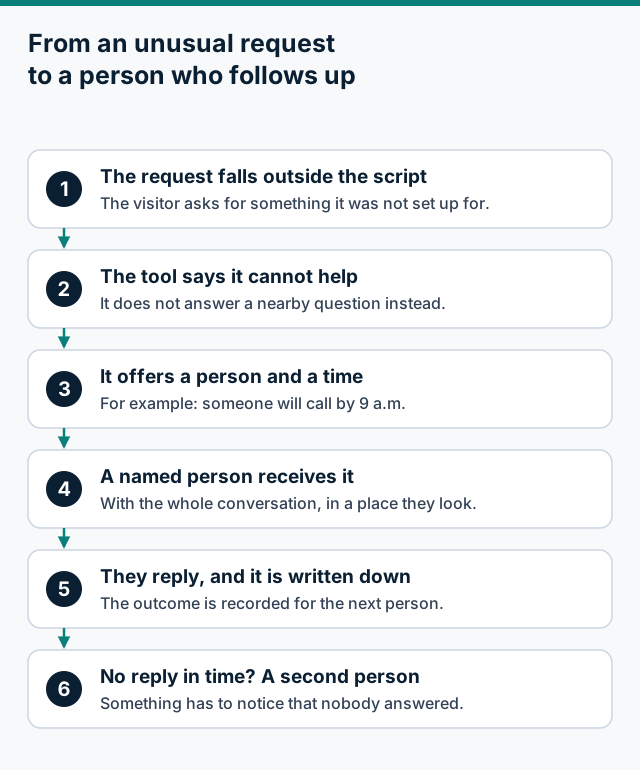
- The request falls outside the script. The visitor asks for something the tool was not set up for.
- The tool says so. It tells the visitor it cannot help with that, instead of answering a nearby question.
- It offers a person and a time. For example, "someone will call you by 9 a.m."
- A named person receives it, with the whole conversation, in a place they actually look.
- That person replies, and the outcome is written down.
- If nobody replies in the time promised, it goes to a second person.
| Step | What usually breaks |
|---|---|
| 2. The tool says so | It answers a nearby question instead, because it was never told what "outside the script" looks like. |
| 3. It offers a person and a time | It promises "someone will be in touch" with no time and no owner. |
| 4. A named person receives it | It lands in a shared inbox that nobody owns. |
| 5. The outcome is written down | The reply happens by phone and is never recorded, so the next person starts from nothing. |
| 6. A second person if nobody replies | Nothing is set up to notice that the first person did not reply. |
Using a chatbot and following up on what it produces
A chatbot and a follow-up service solve different problems and can run side by side. The chatbot captures more conversations. Following up on the ones that stall, the estimates that went quiet and the old leads nobody called back, is the part a person has to do. Vayna's 30-Day Revenue Recovery Pilot is that part, delivered by the founder by phone under rules you approve. It is not a chatbot and it does not replace one. The comparison with chatbots sets out which problem each one fits.
Next step
If a chatbot or a contact form is your first line, a Lead Leak Check is a free way to see where the handoff from "someone asked" to "someone followed up" may be breaking.