

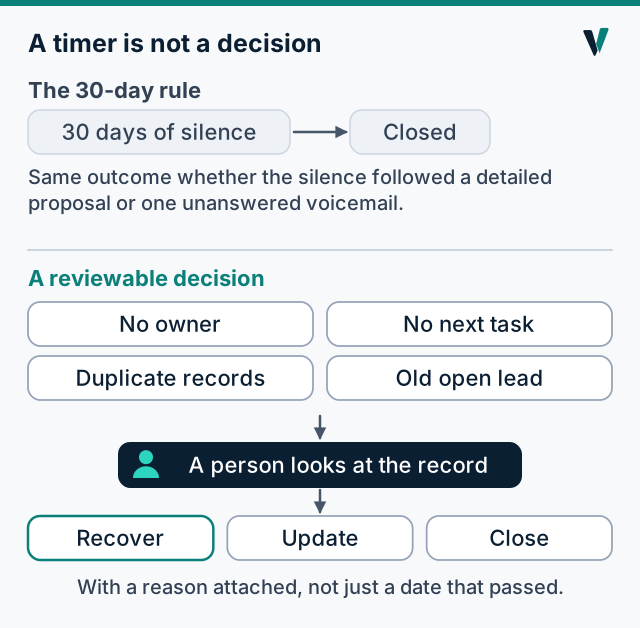
Thirty days of silence is the informal rule many teams use to decide a lead is dead. It is easy to apply and easy to explain. It is also a timer standing in for a decision.
Age is a reason to look, not a verdict
How long a record has been quiet tells you that someone should look at it. It does not tell you what the customer intends, and it does not give anyone permission to contact them. Silence means different things on different records. A lead that went quiet after a detailed proposal is not the same as one that went quiet after a single voicemail. Thirty days of nothing might mean "not interested," or it might mean "interested, but the timing was wrong and nobody checked back."
Use your own cycle, not a universal number
A threshold only makes sense against how long your own jobs take to decide. Work it out from your last few won and lost jobs:
- How long from the estimate to the customer's decision, on a typical job?
- Which jobs take much longer, and why (a roof, a remodel, an insurance claim)?
- What is the longest a customer has taken and still bought?
Set the review trigger a little past your normal range for each kind of job. A gutter repair and a full re-roof should not share one number.
What the review should find
Four questions matter more than a day count:
- No owner. A lead exists, but no one is clearly responsible for the next step.
- No next task. The opportunity has a status, but no practical action attached to it.
- Duplicate records. The same person or company shows up in more than one place, splitting the history.
- Old open leads. The record is still open, but no one has actually decided what should happen to it.
A decision tree with four outcomes
When a record passes your review trigger, a person asks three questions, in this order, and lands on one of four outcomes.
- Is there a reason not to contact them? They asked not to be contacted, the number or email is wrong, or the record is a duplicate. If yes: close or merge it, and record why.
- Is there a reason to follow up and a permitted way to reach them? An open estimate, a stated future date, a question left unanswered, and a phone number or email they gave you. If yes: follow up once, with a short reviewed message, and record the result.
- Is it unclear? The record is thin, or you cannot tell what happened. If yes: update it: add the owner and the missing context, and set a date to look again.
- If none of those apply: close it as closed, with the reason, not as a date that passed.
An example of timing and context
Two records, both quiet for 45 days, in a business whose typical estimate takes about three weeks to decide. The kitchen-remodel quote went out with a note that the customer was waiting on a loan decision: past the usual range, but with a stated reason, so one reviewed follow-up is worth sending. The gutter-cleaning inquiry had a single voicemail and no reply: not worth a sequence, and a reason to close it with a note. Same age, different decisions, because the decision came from the context and the business's own cycle.
Next step
If "we close leads after 30 days" is the policy today, it is worth checking how many of those closures were real decisions and how many were a timer running out. The free Lead Leak Check is a written review of where follow-up may be slipping, and the roofing worksheet lets you count your own old records first.